
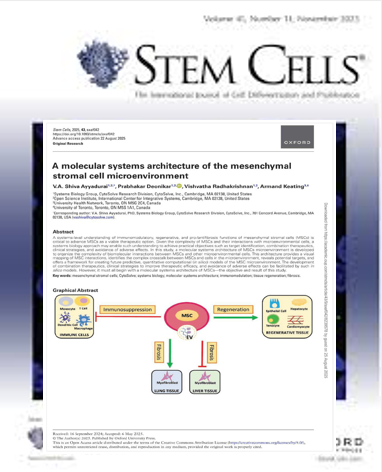
Mesenchymal stromal cells (MSCs) play a central role in tissue repair, immune regulation, and disease progression, yet their biological effects are often described inconsistently across studies. This paper applies a systems biology approach to systematically organize the molecular interactions governing MSC behavior across immune cells, epithelial cells, fibroblasts, hepatocytes, and cardiomyocytes. Using a rigorous literature review and CytoSolve®-enabled systems architecture methodology, the authors construct a multi-layered interactome linking MSC-secreted cytokines, growth factors, and extracellular vesicles to key biological outcomes such as immunosuppression, regeneration, fibrosis, and anti-fibrosis. The resulting molecular systems architecture demonstrates how MSCs exert context-dependent effects—suppressing immune responses while simultaneously promoting regeneration or, in pathological contexts, contributing to fibrotic disease. By mapping these interactions across signaling pathways including TGF-β, IL-6, NF-κB, VEGF, and Wnt, the study provides a predictive framework for evaluating MSC-based therapies. This work advances regenerative medicine by replacing descriptive MSC biology with a mechanistic, systems-level model suitable for therapeutic design, optimization, and translational decision-making.
